
In my previous posts on the the Archetype of the Druid, I trace my personal journey. Literary figures (Gandalf, Merlin, Sherlock Holmes, and Hari Seldon) shaped my intuitive understanding of the kind of person I wanted to be, and (along with guidance from community and Spirit) ultimately led me to find Druidry in the modern world. I speak from inside that experience, as someone who has walked the Druid path for nearly two decades.
But now I want to turn to the Witch archetype, and here I find myself in different territory. I’m not a Witch. I don’t practice Witchcraft. And while I’ve spent years thinking about archetypes (as a Druid, a writer, and a linguist), and I have known plenty of Witches of various flavors, I cannot, and will not, speak for Witches about what the archetype means or how it functions in the spiritual life.
What I can do is what I’ve always done: observe how words are used, how archetypes appear in narratives, and how thoughtful, skilled authors explore questions of power, transformation, community, and the sacred. And rather than speak for Witches about their archetype, I can elevate the voices of Witches themselves, letting them share their own perspectives on how the archetype functions in their lives and their Art.
Archetypes and Authors
Recently, I had the privilege of reading three exceptional books that feature Witches as central characters, written by authors who bring very different perspectives to the archetype. So I did what any curious Druid-writer-linguist would do: I reached out to these authors and asked them about their relationship to the Witch archetype.
As a linguist, I’m fascinated by how concepts function as prototypes. We recognize a “witch” or a “druid” not through strict definitions but through family resemblances, central examples, and fuzzy boundaries. I explored this idea years ago in a post about pagan archetypes. At that time I suggested this general prototype:
The prototypical witch is female, works with herbs, magic, and the moon, is individualist, and holds hidden power.
Let me be very clear: a prototype is not a definition. A prototypical bird is a sparrow, and a prototypical house has a yard and a driveway, but this is certainly not true of all birds and all houses. It is just a typical, default instance of the class. So there certainly can be male witches who are allergic to herbs, hasn’t yet learned to cast spells, hates moonlight, is an extroverted partygoer, etc., but he would, I think we’d all agree, be an atypical witch.
But that’s just my opinion. I wanted to know: what are the prototypical features of the Witch for these authors? For those who are practitioners, how had their spiritual journeys been shaped by literary or media depictions of Witches? Was it similar to the way my path had been shaped by wizards, scientists, and wandering sages? And for all of them, how did they approach bringing this archetype to life on the page?
Paths to the Mountaintop
Their answers surprised me. Unlike my own journey to Druidry, where fiction played a central role, and guided me towards finding other teachers (Spirit, practicing Druids, and historical research), these authors (including two practitioners) told me that media depictions of Witches had minimal influence on their understanding of the Craft. Instead, their visions emerged from lived experience, ancestral connection, research into historical practice, and direct spiritual encounter.
And to be fair, I don’t know that my own experience with Druidry is particularly common. It’s fair to say that most Druids I speak to were first drawn to it from historical research or mythology, not modern fiction.
But even if media portrayals didn’t shape these authors’ spiritual paths, they’ve each created remarkable fictional Witches who are shaping how readers encounter the archetype. Their characters are complex, powerful, grounded in research and practice, and deeply compelling. They offer readers something far richer than the usual Hollywood stereotypes (we’ll get to those in the second part of this post). These are Witches who heal and transform, who are at home working in community or standing alone, and who draw on deep historical roots while confronting contemporary crises.
I want to share their work with you, and share their words about how they approach the Witch in fiction. These three authors are doing vital work that (in the greatest tradition of the Witch) transforms our understanding of Spirit, challenges our assumptions about power and resistance, and explores the edges of fantasy.
BrightFlame
BrightFlame (she/they) writes, teaches, and makes magic towards a just, regenerative world. Her debut novel The Working is a powerful and engaging story at the intersection of modern life, ancestral spirits, and practical community action. It is also an example of Solarpunk, a social movement that works towards a future where humanity and nature are interwoven and mutually supporting via renewable energy, sustainable technology (both advanced and ancient, as needed), and mutual social support. To the extent the book is a blueprint for that kind of society, it is itself an act of Solarpunk.
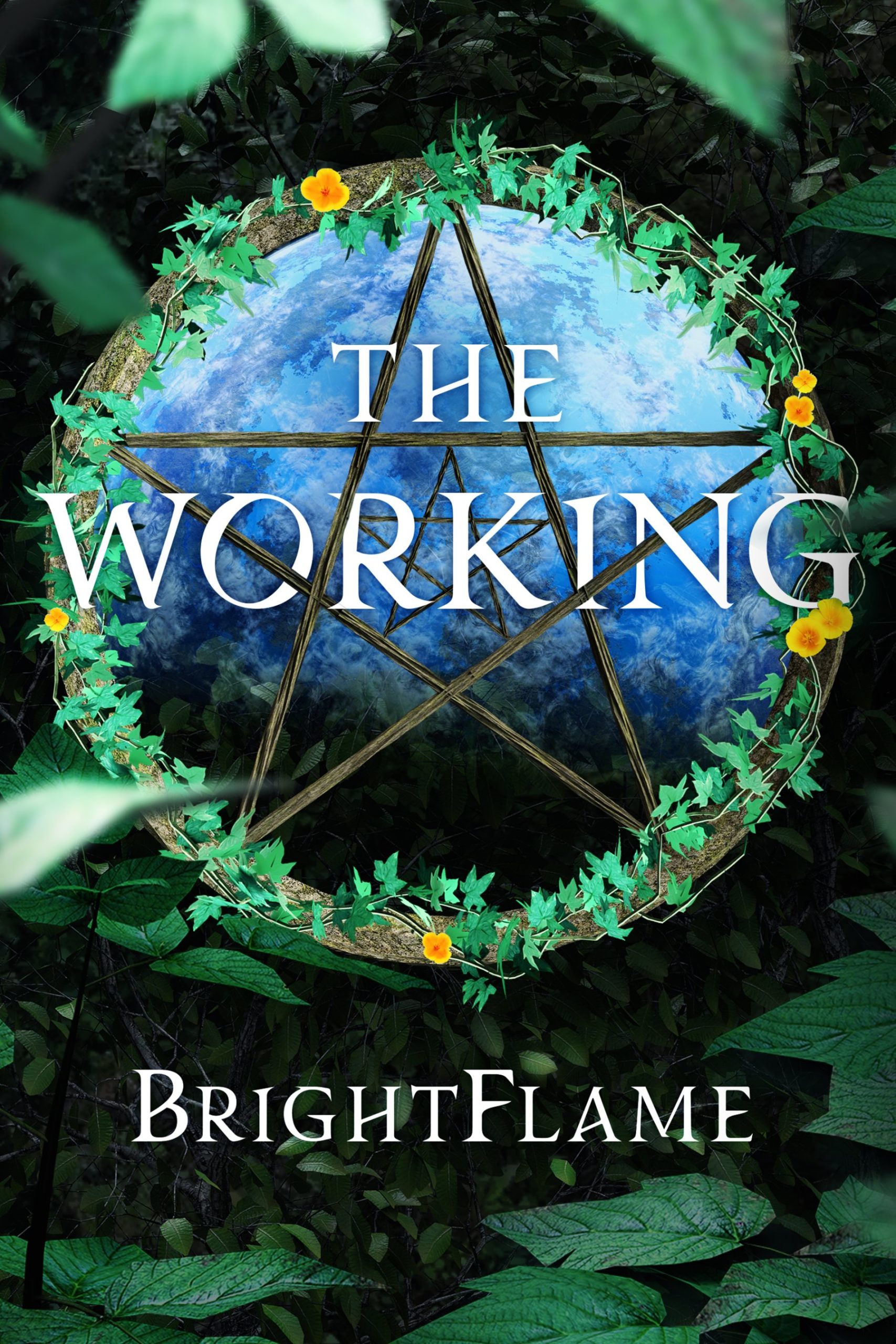
The Working tells the story of a coven in the New York area confronting a devastating environmental threat tied to a spiritual monstrosity. With the help of ancestral Witches, they discover a world-changing ritual called the Working. Each member wrestles with identity, ethics, and community, but their magic combines activism and the spiritual act of healing. It’s a gripping read with compelling characters and deep, practical ideas. I think depictions of earth magic like this — whether interpreted as fiction or not — can be a powerful force for influencing peoples’ perceptions of what’s possible.
Below are some questions I posed BrightFlame after I read her book, asking her about the influence of literature and media on her idea of what it means to be a Witch.
As a practitioner and an author, how has your spiritual journey been shaped by literary or movie / tv depictions of witches? Were there any inspirations or role models?
My spiritual journey wasn’t particularly shaped by media depictions of Witches. However, many decades ago—way before anyone knew of controversies surrounding the author—I yearned for the kind of spiritual connection with the land, and bonds of community and guilds, depicted in books such as Thendara House and Mists of Avalon. These and books that countered patriarchy influenced my journey. (I find them problematic now.) The main intention of The Working is to figure out: How do we fight those who cause not only the climate crisis but all the interconnected injustices in the world and harm the Web of Life? I truly wanted an answer and wrote my way to one. A secondary goal of the book is to offer real Witch practice for those who seek, especially younger people who might be overly influenced by stereotypes and tropes. My book counters such depictions. Through the years, my students asked me to write a book about my flavor of the Craft. Since I prefer to read fiction, the book is my answer. Lots of goodies buried in The Working. (Fun fact: I’m working on a nonfiction book based on my Solarpunk Pentacle workshop.)
In your writing, do you draw consciously on literary witches or archetypal figures? Or do you find that characters like Betsy, Tal, Fire, etc. evolve more organically from your own experiences?
My characters are not based on literary Witches. While the five in the coven each resonate with a different element (Air, Fire, Water, Earth, and Spirit), they are not meant as elemental archetypes.
My Ancestors told me to write this book. I knew that some of their messages would show up in The Working via the Old Ones in the story. And I knew the main characters would be a coven of five. I used both writerly and Witchy tools to get to know them. They told me their stories and answered my plot questions.
I’m so happy that others relate to the five coveners and see them as unique individuals. I hope Betsy, Sail, Fire, Mari, and Tal—as realistic literary Witches—will influence people’s journeys.
With regard to other practitioners of modern witchcraft that you know, how typical do you feel your journey is? Do you feel that literary portrayals of witches play a similar role in their spiritual paths?
Many practitioners come to a Witchcraft Tradition through seeking an Earth-based spirituality—they knew the Earth as sacred and sought allies and teachers both human and non-human, including the gods. Many picked up Starhawk’s wonderful book The Spiral Dance. Unlike me, some were also influenced by pop culture depictions of covens and Witches, but I can’t say how common a path that was. I’m in my sixth decade. I think younger people have more literary and film models than I did.
Margaret McNellis
Margaret McNellis is an author and writing coach who focuses on historical fiction and romance, but who is not afraid to allow magic into the tale. Her writing is emotionally and physically visceral, taking you right into the heart and body of the character in a way few writers can. Her book Daughter of the Seven Hills follows a Roman woman 1,000 miles from the heart of civilization all the way to Britannia and beyond. It is a story of people cast out from the center of society to the margins, and the meaning and empowerment they find there in the liminal spaces.
Although the word “witch” is not used in the book (one character practices Roman magic, and the other Druid magic), their power emerges from these edges and margins. It is a potent force of healing and transformation, centering the characters squarely in the Witch archetype.
When I asked Margaret about the ways literature and media might have influenced her writing and her spiritual path, she had this to say:
When I was in high school, Wicca became very popular thanks to movies like The Craft. But I didn’t practice spells at that time. I’d also grown up on movies like Hocus Pocus, books like Roald Dahl’s The Witches, and plays like Arthur Miller’s The Crucible. All of this to say, witchcraft was not painted in a positive light at all in the media I was exposed to in my youth.
In my college years, I read Harry Potter (which presented both “good” and “bad” witches) and The Lion, the Witch, and the Wardrobe. In fact, I didn’t read a lot of stories or watch a lot of films/shows that featured witches in a fictional sense until after I wrote Daughter of the Seven Hills. I did watch some interesting documentaries about the Burning Times, and I read Witchcraze by Anne Llewellyn Barstow. I watched some book-to-screen adaptations such as A Discovery of Witches.
Much of Daughter came to me in meditative visions and dreams, and it wasn’t until after I drafted the story that I got into my research and began reshaping the text into a more cohesive story, and at that point, made decisions about how to represent Druidism and the mystical. My process — and my development of curiosity in these topics — did not follow a linear development, but circled and took tangents and paused at crossroads, taking one path and then doubling back to try the another.
At the same time, I was embarking on my own mystical journey, living into philosophical and Universal questions we may never know the answers to. This book was also reflective of a deep wish of mine to hear from my late father again, to hear his voice giving me advice, and to hone my own sense of identity and belonging in this world.
As a computer scientist and linguistics researcher, my instinct is to try to lock down procedures and algorithms for getting things done. That extends into my own writing process, which is quite structured. But there’s so much value in allowing artistic inspiration (and spiritual inspiration!) to arrive in its own way, organically. McNellis’s powerful work is definite proof of that.
Sharon Lynn Fisher
Sharon Fisher works at the intersection of science fiction, fantasy, and romance, where she mixes detailed worldbuilding with driving plots and passionate characterization. Her novels boldly combine ideas and people from disparate times, places, and genres with playfulness and energy.
Salt and Broom, a supernatural and richly researched interpretation of Jane Eyre, tells the story of a gifted herbalist who is called to Thornfield Hall to investigate the dark fate hanging over its master. Besides her trademark detailed backdrop and compelling narrative, the book is rich with historical color, autumnal mood, and pagan aesthetics. She had this to say about her creation:
The first inspiration for my witchy Jane Eyre was the original text. The book has a very supernatural tone, and Rochester in fact refers to Jane as witch, fairy, elf, and sprite. This appealed to the fantasy reader in me, and my idea with the retelling was to take that aspect to the next level.
I was also inspired by Daughters of the Witching Hill by Mary Sharratt, which is a fictional account of the Pendle witch trials. I really felt a connection to that story, and the magical elements felt very natural and accessible.
One of the earliest craft books I read was Hedge Witchcraft by Harmonia Saille (2012). From there I dove into many others, Maia Toll being another favorite. I referred to some old books too, like Culpeper’s Complete Herbal.
There is also a strong witch community on Instagram, and I learned a lot there, but it was an especially good source for aesthetic inspiration. I really loved the hedge witch vibes of posts by Susan Ilka Tuttle in particular, an herbalist and spirit medium who wrote a green witchcraft book (that provides some terrific historical context) and also sells botanical products.
What I hoped to do with Salt & Broom was create a witch that would appeal to modern readers while respecting the earliest practitioners.
These authors are creating Witches who challenge and enrich the archetype. But what is that archetype as it appears in contemporary media? What are readers and viewers encountering when they think of ‘witch’? In my next post, I’ll explore how the Witch appears across modern storytelling, and what that reveals about our cultural relationship to power, marginality, and magic.




 Druid Journal
Leave a comment