

In his (perhaps controversially titled) book “The Ignorant Perfection of Ordinary People,” Robert Inchausti argues against the idea, common in the early 20th century, that social justice would advance as ordinary people gave up their attachments to religious structures that had, for millennia, held them in servitude. The idea was that religion (whether it be Catholicism, Hinduism, Islam, etc.) was a servant of the upper classes and a tool of their oppression; and as the peoples of the world became more educated and rejected these religions (replacing them with atheism, presumably), they would throw off the shackles of oppression.
The counterexamples of the Soviet Union (an atheist nation with repressive policies) and the United States (a religious country with relative political freedom) did little to dislodge this view. For those who believed organized religion was a bludgeon of class warfare, these were important exceptions, but they would in time be explained away. After all, one could see almost everywhere in the world that religion oppressed people. It was impossible to deny.
But leaders like Gandhi, Martin Luther King Jr., and Lech Walesa found their path to social change by looking deeply into their own religious traditions. Their effectiveness came not from rejecting these traditions, but from drawing on their deepest truths to confront injustice.
Today the US faces a crisis in which many of our freedoms are being stripped away, and in the name of evangelical Christianity. While I personally rejected Christianity long ago, I do not blame Christianity for this situation. (Christianity has been hijacked; but it will yet be saved.) But I am looking to my Druid practice for guidance and strength. The Druid’s Peace Prayer offers a framework for understanding Gandhi’s approach to personal and social transformation – and perhaps our own.
Deep within the still center of my being, may I find peace.
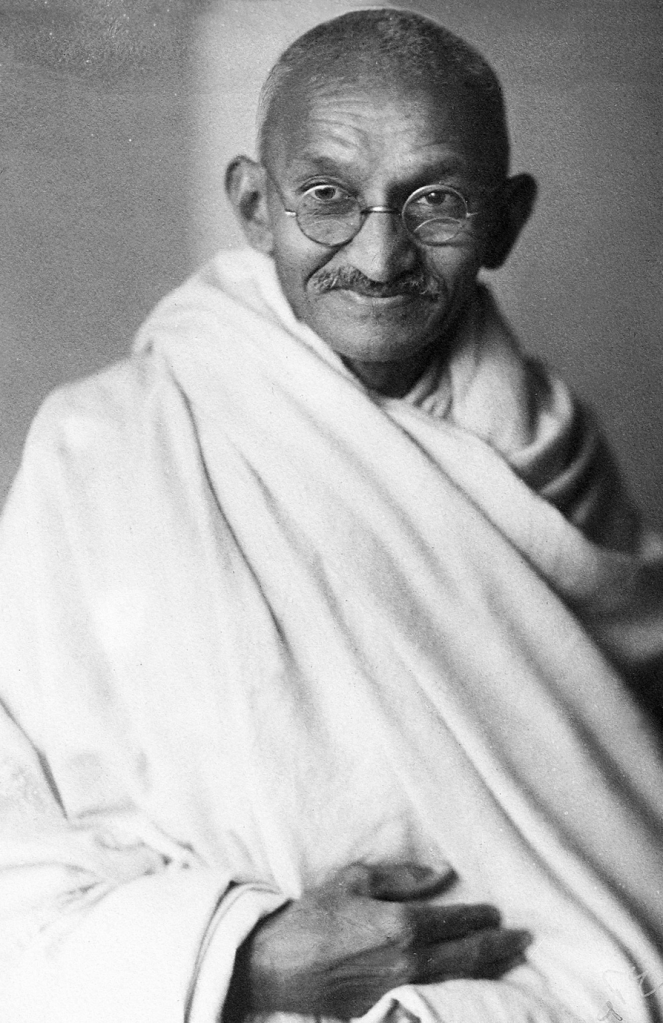
Gandhi’s autobiography, “The Story of my Experiments with Truth,” chronicles his constant experimentation with personal practices: daily walks for health and thought, fasting for deep insight, mantras for spiritual strength. Each trial, each day, was a step toward finding truth. Even his brief experiments with smoking and meat-eating in his youth taught him about his own values and commitments.
The principle of satyagraha – truth-force or soul-force – begins here, in personal practice. For me, this means regular walks in nature, meditation, and prayers to the gods for guidance. Gandhi shows us all that social change requires inner transformation.
Quietly, within the circle of the grove, may I cultivate peace.
But Gandhi also understood that personal transformation requires community. In London, he joined discussion groups and Theosophist circles. In South Africa and India, he built ashrams and working communities. Even his famous Salt March began as a simple, honest action that grew through community support.
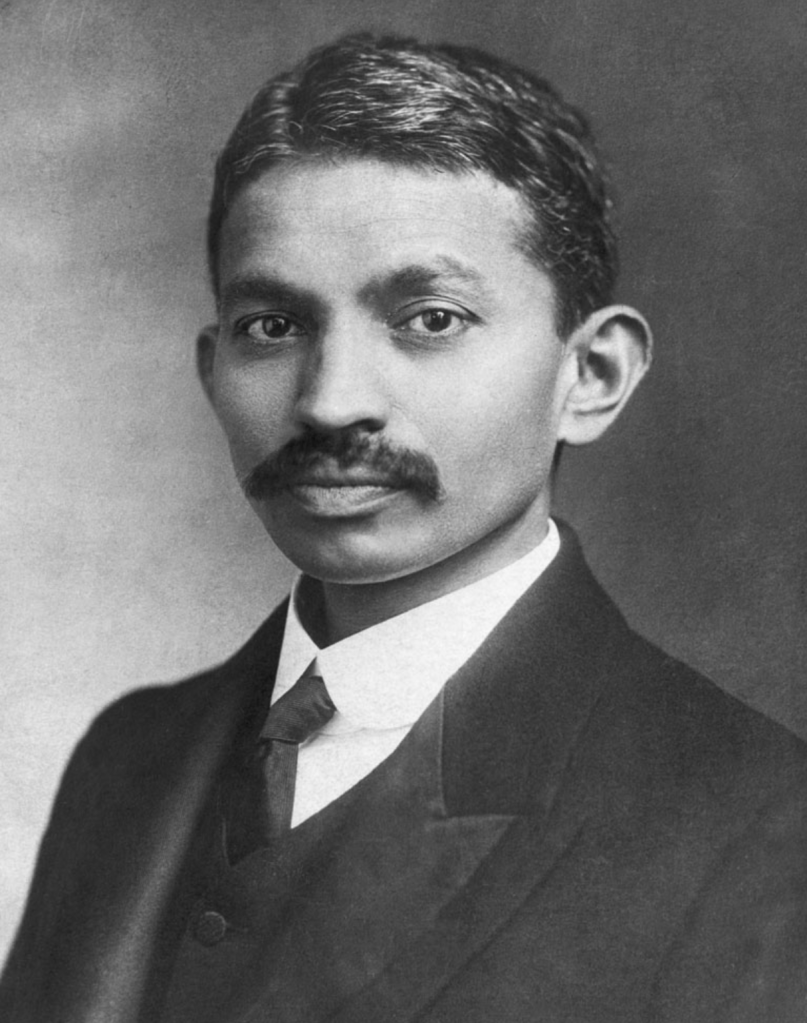
This teaches us something vital about confronting both internal and external enemies: we needn’t struggle alone. By making our efforts visible to allies and building supportive communities, we multiply our strength. Today, some criticize Gandhi as too idealistic. Perhaps, if he’d refused to honor every promise he made, or if he’d accepted violence at one or two critical junctures, India might have achieved independence earlier. Maybe! But if he’d contradicted his principles in such a public way, what would have happened to his support? It was precisely his idealism, rooted in his religious devotion, that inspired such profound dedication in others.
Gently, within the circle of all life, may I radiate peace.
The essence of satyagraha is this: find the truth; resist anything that is not truth; and be willing to suffer courageously and compassionately until your enemy recognizes that truth. Today, as we face mounting challenges to democracy and truth itself, this approach remains, and has proven to be, the most powerful.
I considered not writing at all about current US politics because I like to post things that are relevant in all times and places. Today, though, silence feels like complicity. And Gandhi’s experiments, like the old wisdom of the Druid’s Peace Prayer, are always relevant. They show us the only path forward: to resist without hatred, to stand firm without violence, to find truth and make it visible. And it is our spiritual paths that give us the strength for this work.
The “ignorant perfection” Inchausti describes is not blind faith. It is the recognition that our ancient traditions contain seeds of transformation. When we water these trees with our own experiments in truth – as Gandhi did, as I attempt to do through my Druid practice – we participate in a timeless process of awakening and peacemaking that ripples outward to touch all life.





 Druid Journal
Leave a comment